A következő címkéjű bejegyzések mutatása: purpose. Összes bejegyzés megjelenítése

2014. július 1., kedd

I do holacracy - leadership decomposed, redefined

Leadership is a key element in any organization. While it is defined in several ways almost all leadership concepts work with the following core elements:

building trust, credibility
defining a purpose, a vision, setting values
building sustainable systems to process stuff
supporting people in finding motivation, and fulfilment


This is easy to read but harder to practice. While Holacracy often receives the true critique that it is complex, in reality any cooperation and leadership model has similarly complexity and practical hardships if all elements of it are practiced honestly and at once.

Within its closed system Holacracy incorporates a set of functions that build up to an evolutionary leadership function. I differentiated the following groups incorporating evolutionary leadership sub-functions:

1. Directing functions
- Evolutionary purpose
- Policies

Directing functions help in asking the right questions. Are we heading for the purpose? Are we aligned? Are we acting according to the policies? Purposes and policies have an evolution as tensions surface.

2. Structural and process functions
- Circle and role structure
- Governance and operation processes
The structure of circles incorporating each other and the roles result in an aligned tree of purposes. Changes in the structure are also evolutionary. The processes ensure the evolutionary operation.

3. Roles enhancing purposeful cooperation
- Lead link - holding the purpose of the circle
- Facilitator - running the meeting and putting out fire
- Secretary - steward of all records
- Rep link - representing the circle, holding the purpose one level up 

These roles must be filled to run the circle. It is key that the lead link may not overlap with the rep link and the facilitator. Otherwise the lead link may turn out to be a single point of failure or a role-holding Partner with too much power. 


4. Self-leadership, self-management
- Autonomous work,
- Tension driven proposal
- Right to vote
- Right to take individual action


Self-management is also a key concept in Holacracy. Work is to be done in a GTD manner. For that the roles are a hundred percent empowered by the Holacracy Constitution. Roles have authority to do their work and to impact the way the circle is run.


As you see holacracy is not dealing with people. It is channeling personal energies via roles and processes for the purpose. People lead themselves. Also it does not describe a system further then basic cooperative decision makings and election.


All these do not build up traditional leadership. These are a set of balanced functions that enhance the organization to make changes and steps in small increments, validating them all the time. People have space to grow up and act as adults and learn as children.


2014. június 30., hétfő

I do holacracy - an inside out structure

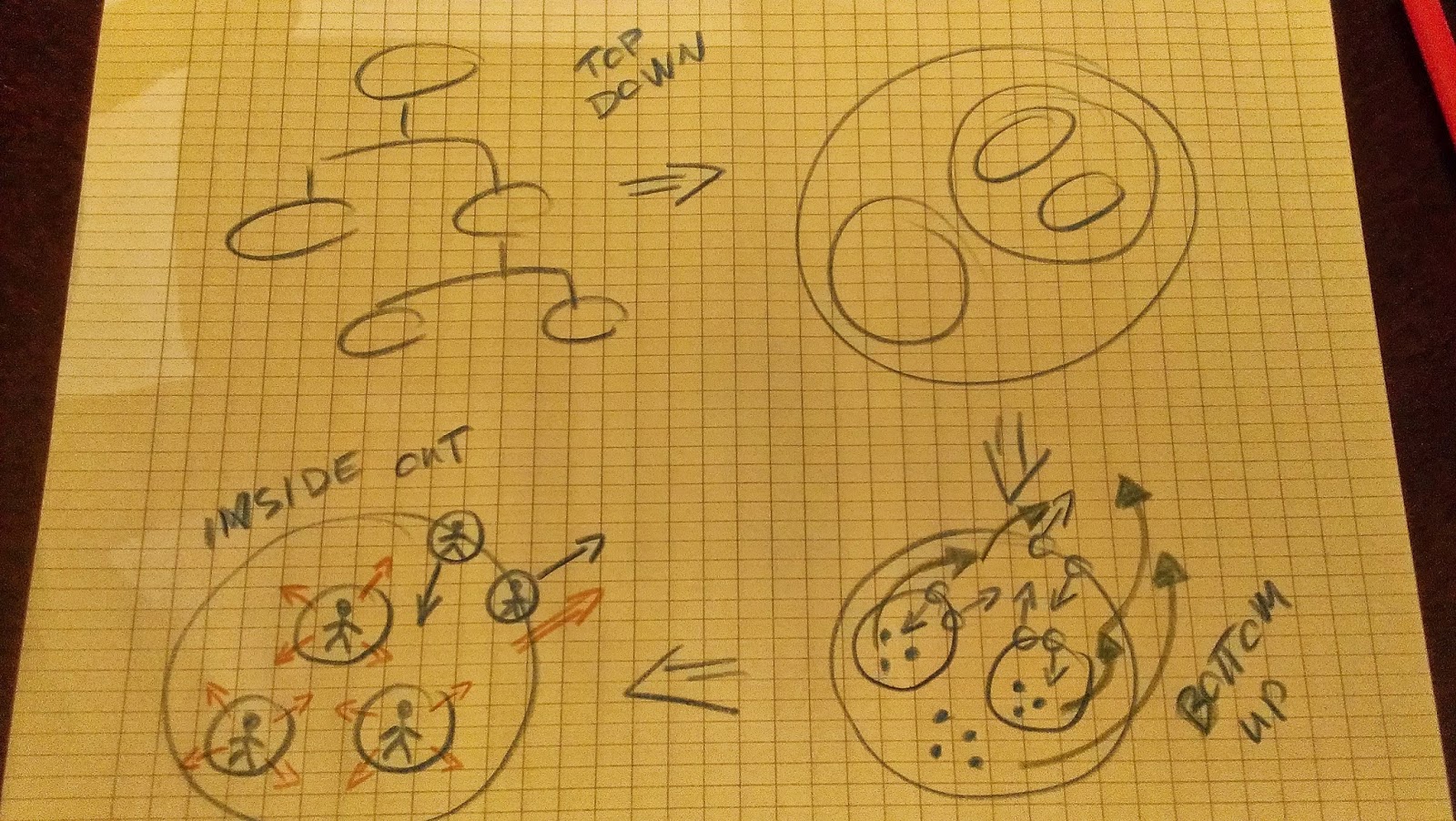
There are discussions about the structure of Holacracy being hierarchic, but still showing charachteristics of a flat culture. How can that be? I have found holacracy building the structure three different ways.

Firstly it is top down, since its initial structure is derived from the anchor circle and its purpose. Also from an initial proposal. As the differentiation in the first circle cascades down to the final roles, the first iteration of the hierarchy appears.

Secondly, the hierarchy is bottom up. Each and every tension felt holds the potential to affect the organizational structure. One proposal may go on smoothly without objection, another may be escalated (via the rep link) to result in a new role or circle on a higher level. It may even alter the company purpose.


The third direction is inside out. Defining the purpose is creating a higher consciousness in a circle to reach deep down for our shared values, passions, principles and anything that drives us. The purposes of circles higher in the hierarchy may be more abstract, while granular roles may have very specific purposes. Anyway, to have clarity the conscious work on defining the alignment of purposes needs to be done.


The clarity in the aligned purposes of roles and circles has an impact on the overall consciousness of the role-holding partners. Personal energies are freely flowing and filling the roles since the tensions and obstacles are constantly removed. This energy fine-tunes the structure by adjusting the roles to the personal element.


Holacracy is neither flat nor bottom up. These terms are not useful to describe it. Holarchy works differently in different phases of the organisation. Did you experience it?

2014. május 18., vasárnap

I do holacracy - when hierarchy works

I experience that holacracy effectively disables, kills, slaughters, eliminates, eradicates, micromanagement.

Micromanagement usually happens, when people with authority are asked or they chose to take responsibility for the decisions of subordinates. This is never an uplifting story. It creates the image of one as a responsible, strong, capable, rescuer and the other as someone weak, incapable, who is not taking responsibility, and who needs to be saved.

Micromanagement is eliminated by the following things:

1. Distribution of authority - In holacracy power is distributed in a way that each role can and should do its job without unnecessary approvals.-

2. The integrity of roles and circles - Each role and circle is defined with a clear purpose. The role holder is firstly responsible to fulfill that purpose via her accountabilities. That makes a deeper commitment from the role holder reducing the chance of pushing responsibility away.

3. Defined domains - Since domains and accountabilities are defined for each role, any peer may express their tension if the work on your part is not done or not done according to what is the common understanding of your role's purpose within the circle. If the role of your peer is blocked, he can ask wether your role needs help, he may take individual actions and if the case is severe he may propose that certain accountabilities of your role are to be taken to make the work more even and fluent.

4. Healthy hierarchy - Or in other words, natural hierarchy. As no cellular structure is interested in molecular issues by its nature, no super circle is dealing with the issues of roles in the sub-circle. By its nature a governance meeting (derived from the constitution) is simply dealing with locally felt tensions that affect the present operation. In any super-circles the rep links and lead links present their tensions as speakers of the sub-circle, never as one role within that.

Where micromanagement may happen is the cooperation of a role and the lead link role within the same circle. But I experience that those partners who hold clarified roles, understand their purposes and hold themselves accountable are not the ones (or they are very hard) to micromanage. Also the lead link role is not a typical managerial role. It is just another role serving the circles purpose that can be criticized, helped, and further clarified.

Welcome to the world of pain felt, responsibility taken, decisions made and work done where and when it should be!

2014. március 13., csütörtök

I do Holacracy 7. - facilitation tips

There are some key factors for effective meeting facilitation even when the holacracy constitution inclues the meeting steps. Even when people seem to be open and willing to participate.

Defining circles, roles and stategies may take longer, may need more questions and a longer response time. Integrating relevant responses may take time as well.

Procrastination is an evil thing. It can steal your time even when you have minutes or seconds. Therefore I focus on minimizing question and answer time. 

If you have a day to answer, you tend to use the whole day for thinking, if you have five hours, you tend to use all of it hours. But if you have only 60 seconds, surprisingly you are able to give almost the same quality answer or decision. The reason is that most of the time we already have our ready preferences, reasons and answers unconsciously.

To get fast access to these ready answers I usually give a 60 second timeframe when the answer is a list of words and a 120 minutes timeframe when I ask for a sentence.

About collaboration tools: I love to use a whiteboard when listing values, ideas. To prioritize I ask the circle members to stand up, grab a marker and mark the preferred words on the board. Post its are great as well. A snapshot of the whiteboard posted to a g+ community supports the participation of group members who join via hangouts or skype.

About understanding each other: In my experience the first thing to take into consideration, that some people focus on solving problems and some focus on setting goal. According to Bobb Biehl's work goal setters prefer to add new elements to the current system, while problem solvers prefer to fix already existing element the same time. Therefore their tensions are not understood easily by the other. While supporting the integrated decision making process you need to help the folks with different paradigms to respect and to understand each others tensions.

2014. március 3., hétfő

I do Holacracy 4. - defining the mission

What is a mission statement? For me the mission is the answer to the questions below.
- How do we contribute to the company, to the super-circle, to the product, or how do we add value to the customer?
- Why are we existing, why are we here?

I use these questions to clarify the mission statement, when there is already a sentence. But before asking a question I like to map the words the group has in mind or has a positive relation with.

For the start I ask all group members to write down all the words they recall thinking about our group. You may need to help the group if they tend to neglect verbs. Verbs are extremely important for a mission statement. This results in a long list.

Next is to clear the long list:
- Erase duplicates.
- Choose between synonims, if there is no difference in meaning.
- Erase most of the adjectives (a credible mission statement does not states anything about the quality of the contribution before the customer experiences it).

Then prioritize the clear list in 3 rounds
- Make all members underline or mark as many word as they find important about the group.
- Make them mark again those that they find extremely important.
- Get them to mark those that express the core existence, operation or values of the group.

Now it's time to write down the first sentences. This is a private assignment. If some members feel it impossible to write something down, let them know that it is completely ok to write a very simple sentence or just a series of words. Its not literature, its finding a sentence (or some words) that expresses both a conscious and an emotional relation between all of the members and the group purpose.

Next is to pivot the sentences. Read the sentences aloud and feel free to relfect on them (Facilitate the rounds strictly, make them fast). Focus on making positive reflectios. If you feel like making negative reflections only state what you miss from the sentence and make suggestions. At the end of the round choose someone’s sentence to go on with in the next rounds. You may choose more, but keep in mind the goal is to converge the versions into one final.

Make some more rounds with highlighting the positive elements of what you heard and suggesting alterations. In case of negative critics always make everybody suggest, never let anybody demand altertions. If one can’t make suggestions she may ask for help.

If the group is open enough and communication is finetuned already the chance is high that you have a good sentence in some short rounds even if you skip the part with mapping the words. 

But be patient and note these:
- There are nations with relatively passive language and thought patterns (compared to English) where a purpose/mission statement is not part of the usual best practices. There you may need the word mapping parts.
- We people are thinking and expressing ourselves very differently. And I mean VERY differently.
- People find motivation in different values, different actions, and different phases of the very same process.
- Some people like to set goals, some like to solve problems, some like to work in opportunities. These people think and speak differently about the same issue
- Usually people are at different level of emotional and social maturity and that may poison the communication of some issues.
- People have different ambitions. Some aspire to be captains, some to be strong players, some to be middle captains.

These are completely ok. This is the human framework you have to work in to forge a common purpose.

One more thing. And this may be valuable for you as well.

After finalizing the mission statement. Don’t discard all the working papers. Have a 5-10 minutes session to collect all the strong words you came up with but left out of the final version. These may be part of a valuable principle, a value list or a policy. Thinking over these words you may have better grasp on the strategic next steps.

Hope you found it useful!


By the way... Do you do it differently? What is your way?