A következő címkéjű bejegyzések mutatása: consciousness. Összes bejegyzés megjelenítése

2014. október 15., szerda

About measuring Holacracy 1.

I suppose holacracy is usually sold by great stories, testimonials and reasoning around key values. I have bought the idea about a year ago in a taster workshop, but I was unable to resell it the same way.

For a long time I thought I was missing a piece. Luckily I was patient enough to let time work for me and by now it turned out that mostly others missed pieces. Also today there are some fellows who have actually found their pieces. But that is far from enough.

Missing a piece may mean missing a whole different prespective.

During getting to know holacracy I have learnt that human consciousness has typical stages. On top of that it is not surprising that human cooperation has the very same stages. Between developmental stages there is a need to make a leap. And that leap is frightening. It is a crisis for the mind. It is a crisis for the cooperation as well. But adoption is always a result of a crisis. In some cases a proactive one, in others a reactive one.

What I did not see when I dived into this complex organizational transformation project that I tried to force more than one step a time.

To be able to adopt holacracy you have to be prepared to change several things at once:
- The way you look at work
- The way you do your work
- The way you communicate at work
- The way you do meetings prepare and make decisions
- The way you govern, build strategy and sense operations

All this at once. That is the hard part. It is such a cultural shock that even very intelligent people back off when trying it. Some do it consciously and admit their hardships while others explain themselves that holacracy is wrong. I admit I backed off several times.

Our mind protects itself from accepting new perspectives. It is a risk for our integrity. 


I came to the conclusion that there is a clear need for data and facts that lie behind the great stories and testimonials. I want to start a conversation with you about measuring holacratic operation. Some future holacracy users demand tangible results as rewards. For some ROI is simply necessary to start a deployment.

In a next post I will further explore the ways how holacratic operation could be measured. Please do not hesitate to join in a conversation about it.

2014. július 1., kedd

I do holacracy - leadership decomposed, redefined

Leadership is a key element in any organization. While it is defined in several ways almost all leadership concepts work with the following core elements:

building trust, credibility
defining a purpose, a vision, setting values
building sustainable systems to process stuff
supporting people in finding motivation, and fulfilment


This is easy to read but harder to practice. While Holacracy often receives the true critique that it is complex, in reality any cooperation and leadership model has similarly complexity and practical hardships if all elements of it are practiced honestly and at once.

Within its closed system Holacracy incorporates a set of functions that build up to an evolutionary leadership function. I differentiated the following groups incorporating evolutionary leadership sub-functions:

1. Directing functions
- Evolutionary purpose
- Policies

Directing functions help in asking the right questions. Are we heading for the purpose? Are we aligned? Are we acting according to the policies? Purposes and policies have an evolution as tensions surface.

2. Structural and process functions
- Circle and role structure
- Governance and operation processes
The structure of circles incorporating each other and the roles result in an aligned tree of purposes. Changes in the structure are also evolutionary. The processes ensure the evolutionary operation.

3. Roles enhancing purposeful cooperation
- Lead link - holding the purpose of the circle
- Facilitator - running the meeting and putting out fire
- Secretary - steward of all records
- Rep link - representing the circle, holding the purpose one level up 

These roles must be filled to run the circle. It is key that the lead link may not overlap with the rep link and the facilitator. Otherwise the lead link may turn out to be a single point of failure or a role-holding Partner with too much power. 


4. Self-leadership, self-management
- Autonomous work,
- Tension driven proposal
- Right to vote
- Right to take individual action


Self-management is also a key concept in Holacracy. Work is to be done in a GTD manner. For that the roles are a hundred percent empowered by the Holacracy Constitution. Roles have authority to do their work and to impact the way the circle is run.


As you see holacracy is not dealing with people. It is channeling personal energies via roles and processes for the purpose. People lead themselves. Also it does not describe a system further then basic cooperative decision makings and election.


All these do not build up traditional leadership. These are a set of balanced functions that enhance the organization to make changes and steps in small increments, validating them all the time. People have space to grow up and act as adults and learn as children.


2014. június 30., hétfő

I do holacracy - an inside out structure

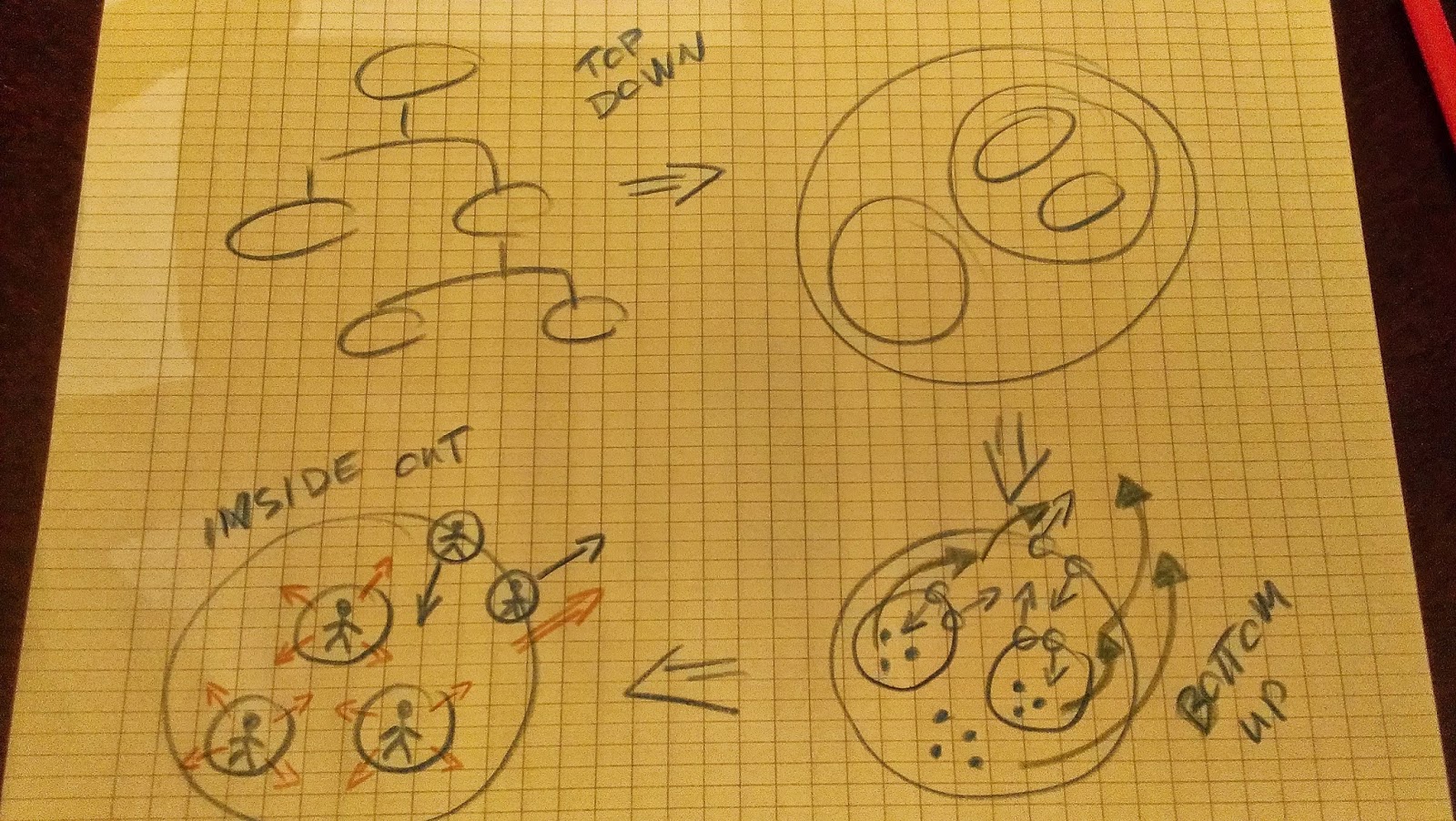
There are discussions about the structure of Holacracy being hierarchic, but still showing charachteristics of a flat culture. How can that be? I have found holacracy building the structure three different ways.

Firstly it is top down, since its initial structure is derived from the anchor circle and its purpose. Also from an initial proposal. As the differentiation in the first circle cascades down to the final roles, the first iteration of the hierarchy appears.

Secondly, the hierarchy is bottom up. Each and every tension felt holds the potential to affect the organizational structure. One proposal may go on smoothly without objection, another may be escalated (via the rep link) to result in a new role or circle on a higher level. It may even alter the company purpose.


The third direction is inside out. Defining the purpose is creating a higher consciousness in a circle to reach deep down for our shared values, passions, principles and anything that drives us. The purposes of circles higher in the hierarchy may be more abstract, while granular roles may have very specific purposes. Anyway, to have clarity the conscious work on defining the alignment of purposes needs to be done.


The clarity in the aligned purposes of roles and circles has an impact on the overall consciousness of the role-holding partners. Personal energies are freely flowing and filling the roles since the tensions and obstacles are constantly removed. This energy fine-tunes the structure by adjusting the roles to the personal element.


Holacracy is neither flat nor bottom up. These terms are not useful to describe it. Holarchy works differently in different phases of the organisation. Did you experience it?

2014. május 3., szombat

I do holacracy - how we changed

This post summarizes my experiences based on six months exploring holacracy in Doctusoft. If you are interested in details you may find more about our story here.

Holacracy changes us. It is a tool we use, but we adopt to it. The tool brings clarity, accountability, but after a while it is us who bring clarity and accountability to life and sustain it via holacracy. I experience a slow but major transformation of me and my colleagues in several aspects. Be prepared to read nice stuff :)

They wish to be part of it.

We have applied holacracy to only one part of the company yet. Since we are a software developer group practicing agile management methods, the project groups were managed quite well. We chose holacracy for the supporting functions like HR, finances, sales. Now these circles are a little bit envied by the developers. They hear about effective meetings, clarity and wish to be part of it.

Personal consciousness in the way we handle issues.

Colleagues started to come up with tensions and suggestions out of the governance meetings. In cases it is not clear in which role did they feel the tension. Lots of roles are not clarified yet. Since undefined roles have no clear purpose it is hard to tell whether the proposal moves the circle forward or backward, but sometimes there is a gut level knowledge about its rightness.

Clearer messages, more attention in communication.

Processing tensions have multiple learnings for each participating partner. I simplified these learnings to focus on the partners' feelings
- I can have my tensions resolved the way I think it is best for me. Perhaps if it does not hurt anybody else. 
- I am not allowed to oppose without reason. I have to face my irrational self if I intend to.
- I see others change after their tensions are resolved. It makes the subjective change of others an almost tangible experience for me.
- I see how "expensive" is fighting and how pointless it is. We have to reengage in governance tension resolution again anyway.
- It happens a lot that I have contextual suggestions or objections that are brought up by another partner before I have time to speak. Firstly my ego wants to be heard, later I start to enjoy that I can save my voice and can trust others to work out the objection we both feel necessary.
- I see that meetings can be effective and informative, less time consuming and less frequent if we start with the tensions and process them.

These learnings provide positive assuring feelings and "aha" experiences that lead to personal confidence, emotional balance, and predictability in the group dynamics.

Real proactivity and responsibility

Circles and roles are clear. So as the constitution. It means that everything I do have clear boundaries and connecting points. The way I work has more autonomy than any empowerment gave me previously, since I am almost self-managing. I fill a role with a clear purpose. If I have any problem or roadblock that is a tension to process that is to be triggered solely by me. If I have no roadblocks the work is to be done solely by me.

Letting things go - transcending the ego

After the most of the evil blocking tensions are resolved people start to get their things done. They have less and less time to focus on positions, pesonal gains, fear, games, and assumptions. Meanwhile they discover that self-managing or at least autonomous work is much more fulfilling than playing daily games for maintaining position, security, whatever. So they step back from the previous conflict zones since those are not beneficial or necessary after all.

All of us experience this which leads to less "threat" and more personal focus. The results are plenty. Just to mention some:
- Success - as etymology says: an advance, a happy outcome
- Reaffirming results
- Responsability taken, being accountable is building character
- Reflection on personal work methods
- Reflection on personal feelings, worldviews
- Assertivity

I experience that holacracy enhances personal growth.

Do you categorize these learning s differently? Have you got anything to add?