I often read that holacracy is described as an operation system. While I completely agree with the similarities I miss more details and sense something funny in this comparison. If we look at holacracy as an OS, we have to admit that we are rather the hardware of the system, than its users. But then who is the user?
In case of organizational structures and operations most often we find the metaphor of a machine. In the metaphor there are the C-level people and the board members who give direction to the machine. They can be considered the users. And there are those who run the machine, they are the bigger and the smaller cogwheels, who are definitely not users, rather parts of the machine.
The metaphor of the machine is ok until you are a user not a part of the machine and the concept of 'spare parts' does not emerge.
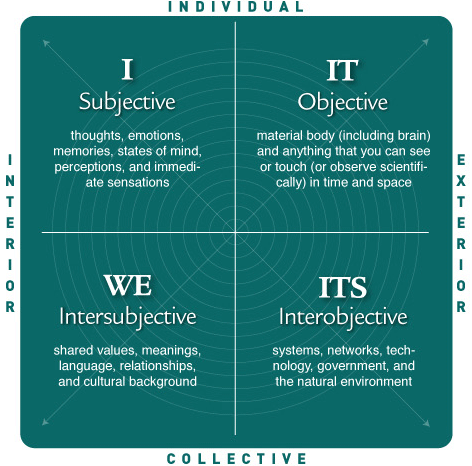
By experience and analysis I tell you Holacracy is more than an operation system. To describe its further qualities I use the four quadrants of the Integral Theory. If you need detailed explanation on the quadrants you may find this useful.
Briefly Integral Theory says everything has four natures. A thing can be viewed individually in itself, or as part of a collective existence. Also everything has an exterior, measurable, outer nature and an unmeasurable interior.
If we view holacracy by its objective (exterior and individual) nature, we see
- An operation system for purposeful organizations,
- That enables agile governance and tactical operations.
- It also has a capacity to harness more personal power via processing tensions
Almost all descriptions stop here.
If we view it by its interobjective nature (exterior and collective) we find
- That the so called OS serves as a platform for more software applications.
- The OS and the Apps together represent a highly differentiated, very conscious cooperational form
- Which has the competitive advantage of differentiating those parts of it that are necessary to run with more consciousness and leaving the others as they are.
- It is written in legal language and updated by versions providing a common denominator for our technology and law defined world.
- It has a capacity to transform machine-like and family-like companies to organism-like ones
The subjective nature (interior and individual) of holacracy could be grasped from the point of view of a single practitioner. It is experienced as a system that:
- Pushes me to complete self-management what is personally fulfilling.
- Provides me clarity in the organization, in my circles, roles, accountabilities, and crystal clear alignment of my purposeful contribution
- Provides me power and space to contribute and means through which I may ask for help and influence change.
- Provides me an everyday experience about the border of my work roles and my private self
The intersubjective nature (interior and collective) is touched by the last slide of the taster workshop, which runs like 'it takes a village to raise an organization'. This intersubjective nature is
- Our shared story of the evolutionary purpose
- The capacity to transform our shared beliefs about cooperation, self-management and self-leadership
- To opportunity for us to evolve our organizational cooperation to a living entity
At this point we have found the User! :-)
To sum it all up.
Holacracy viewed in itself is an operational system for purposeful organizations. Holacracy is experienced empowering by all practitioner partners in the organization, who slowly turn to self-managing role holders withclarity about their work and their private self. Holacracy in a greater context is a very competitive agile cooperation form that may be amended with more compatible applications. It is laid down in a constitution in legal language. It has the competitive advantage of differentiating those parts of it that are necessary to run with more consciousness and leaving the others as they are. Holacracy when practiced together has a certain cultural capacity to transform and transcend our shared beliefs, so we can start to live the story of the living purpose of our cooperation.
Bit more than an operating system, isn't it.
Most of us still look at organizations with the machine paradigm. But in that paradigm holacracy is not fully observable. It simply does not fit in. To grasp more about it first imagine that your organization is rather a living organism than a machine with frictional parts.